
The Tersky Coast of the White Sea
You cannot step into the same river twice. And all the more so, into the same sea.
Last year's trip gave us unforgettable impressions, and in 2015 we decided to go on the White Sea again, but along a different coast this time.
For this year we had several options, including a trip on Baikal, to or from Arkhangelsk, and, perhaps the most insane, along the Barents Sea coast from Teriberka. We dismissed the last one almost immediately due to its practical infeasibility given our current level of training and equipment, and besides, the border zones and 50 kilometers of nature reserve added to an already rocky shore where you can't just land anywhere.
Arkhangelsk seemed not interesting enough to us, and we swapped it for the Tersky Coast. Dasha found a way to get to the village of Sosnovka by helicopter from Lovozero, and we began working out exactly this route, though I admit the choice against Baikal was hard for us: we so badly want to visit there.
And so, once again, as last year, I buried myself in pilot books, maps, and the few and sparse trip reports. By and large, little is known about the Tersky Coast from a kayak's point of view; it has rarely been paddled, mostly on catamarans, and even from those not much information remains. Part of our route, up to Chavanga, had been done by Severnye Prostory, and from their descriptions I was able to mark one place where we could stop and one where you definitely shouldn't.
A careful study of the photographs on Google Earth revealed the spots used by tourists and fishermen for camping, and all of them were transferred onto the only commercially available map of Murmansk Oblast in Moscow, at a scale of 5 km. On the whole it's handy to have a 5-km map with the main reference points and distances marked. This time I measured the distances more carefully, both with a ruler on the maps and with an opisometer, adding 10% on top, and as the result showed, the error was minimal.
Gear
As for the gear, it didn't undergo any particular changes. Regarding the kayak, all that was added was the sail and the steel cables, broken in on the Gulf of Finland. For clothing I bought a new jacket to replace the old, not very comfortable one, and we also bought new Hiko Grip gloves. In view of forecasts of +5 degrees, we also bought membrane pogies that slip onto the paddle. They turned out to be completely useless.
Our camp setup underwent small changes. We replaced our old Jetboil Flash with a Jetboil MiniMo, mainly because of the fine adjustment of the gas flow. This proved very convenient and useful; at last the Jetboil shed its "teething troubles" and became a cooking system rather than just a water boiler.
The most expensive and at the same time most useful purchase was the Hilleberg Nallo 2GT tent.
I spent a long time choosing between it and a Helsport, and settled on the Swedes. The Tersky Coast is treeless along almost its entire length, with absolutely nowhere to hide from the rain, so we had to somehow solve the question of extra space where we could shelter and live during rain. The suspended inner tent and the huge vestibule deftly solved this problem, while the low weight and reliable construction that is the hallmark of Hillebergs make it a truly ideal choice. It's also important that the inner tent isn't mesh, like on our old Marmot, and is in itself significantly warmer. The ability to pitch the outer layer first is a big plus in the rain. The tent goes up in 2-3 minutes, and under the fly it's 3-4 degrees warmer than outside.
The combination of these factors made our daily life as comfortable as possible, which is beyond any comparison with last year.
Instead of Dasha's old Red Fox backpack, which took up a fair amount of space, we buy a Patagonia Black Hole 120L duffel. The main pluses — it weighs 1.3 kg and rolls up very compactly, much better than its counterparts.
In electronics we acquired a new Spot Gen 3, an anemometer, and a new Garmin GPSMAP 78s with a special case minimizing the device's contact with water. As last year showed, waterproof devices are just as susceptible to the destructive effect of salt water as ordinary ones.
For photography we bought our first camera, a Sony RX100 mkIII, and a PeliCase for it, to always keep it on deck.
This time we didn't take a hydration bladder, given its relatively low convenience, and replaced it with ordinary 1.5-liter bottles.
We swapped the knife for a more versatile and convenient one, plus some odds and ends not worth mentioning.
All the experience of past trips was taken into account, and on its basis the best set of gear to date was assembled.
Gear list with approximate weights
We assembled the first-aid kit under the supervision and consultation of a specialist, and, it seems to me, it would have been enough to get a small group of tourists back on their feet. We even had to buy a new case for it.
Here's the contents of the first-aid kit
Food
The meal plan didn't differ much from last year's. An important change was giving up freeze-dried meals: first, they'd stopped being imported because of the sanctions, and second, the jump in the dollar exchange rate made them an expensive pleasure, almost 1,000 rubles a pack. For that thousand, packets of soup and all sorts of add-ins were bought: meat, dried vegetables, and others. It turned out that soups aren't much harder or longer to cook, and in principle they're no less nutritious, so out of the three packs of freeze-dried food we'd taken, we used only one and planned to eat another, if need be, while on the water.
We also added vitamins to the meal plan, which we'd forgotten last year.
You can review the meal plan here
Route
This time we decided to publish the route first, to make it easier to navigate. And some people may not want to read this whole wall of text at all.
StartLovozero → Sosnovka
At the station Katya sees us off, along with Makar, who's traveling to Piter. He deliberately bought a ticket on our train to help us load. Thanks to him, we save a ton of energy, and in gratitude we feed him dinner.
A helicopter insertion in itself requires a different approach. We could have chartered the whole helicopter, but the cost of such a trip wouldn't have pleased us much. So we decided to try our luck and squeeze onto the scheduled Lovozero – Kanevka – Krasnoshchelye – Sosnovka helicopter. It runs once a week, costs 2,776 per person, but the catch is that tourists may not be allowed on if there are too many locals, as the staff of the Lovozero administration informed us. The required two weeks ahead, I called and signed us and our 100 kilograms of cargo up. It's worth saying that cargo there is also regulated, and "you can only take 20 per person, the rest at our discretion."
As I learned, the Mi-8 on this route can take a maximum of 22 people on board, and a simple calculation of the average mass of a person and cargo showed that the helicopter could be loaded with at least another ton of cargo, so I was basically at ease.
We rode to Murmansk on our beloved "Arktika," this time getting acquainted with its dark side — the dining car. It's a terrible place with exorbitant prices, tiny portions, sour-faced staff, some unending shanson or a cop show blasting at full volume by the carriage attendant. You can neither rest properly nor eat, though the dishes are basically tolerable.
In Murmansk, Slava meets us and drives us home. The city is overcast, it's raining, and it's +8-10. That same day we buy some additional food, get Dasha a buff she'd forgotten at home, buy a backup phone — a Nokia "for 1,000 rubles" — and in the evening have dinner in a merry crowd with relatives.
The next morning a minibus, mistakenly ordered instead of a wagon, picks us up and takes us to Lovozero. We stop at the town's only hotel. To be honest, this place looks the least like a hotel of anything: it's a three-room apartment with locks on the doors, but it's something at least. It's +15 inside, and we're already anticipating how our backsides will freeze at sea. We stroll around the village, drop into the museum of Sami culture, eat venison, and go to bed.
In the morning we barely squeeze into the local taxi and are the first to arrive at the airfield; we're a little nervous, seeing that the people coming in after us are also lugging quite a bit of stuff. But our doubts quickly dissipate when the airfield workers aren't too surprised as the total weight of our cargo reaches the 129-kg mark.
They write us a receipt to pay for 89 kilograms of cargo, and, having paid about 8,000 rubles in total, we sit down to wait for departure. By the way, since early June, when we first called Lovozero, we'd been told more than once that a commercial tariff for tourists was planned, around 12-14 thousand rubles. We were prepared both mentally and financially, but bureaucratic red tape apparently stalled the process at some stage, and a week before the flight we were assured the prices wouldn't go up.
Good news: almost everyone is flying to Sosnovka, and it will be the helicopter's first stop.
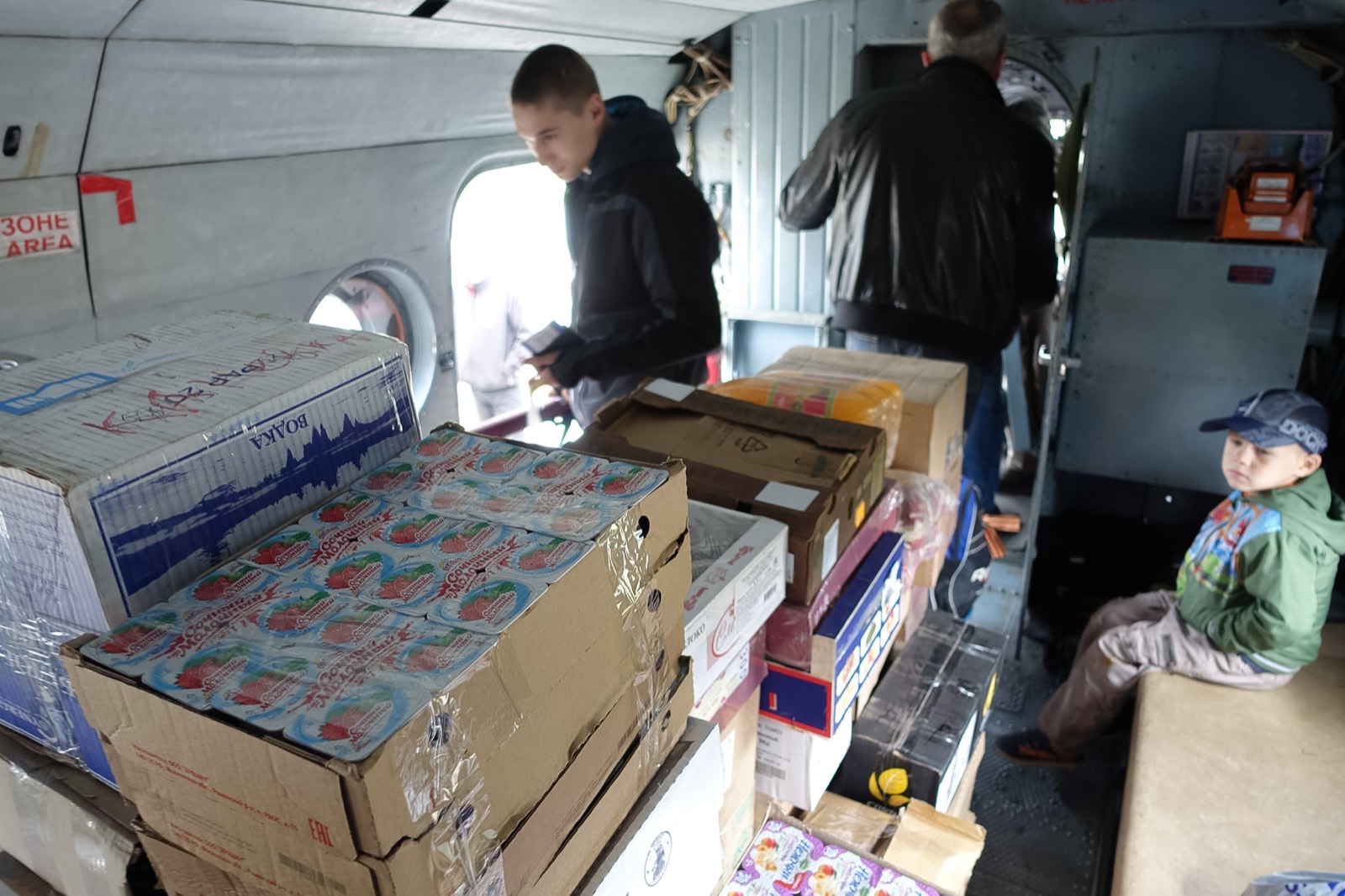
The crew is a little delayed. We load into the helicopter. It's almost entirely packed with provisions, with a pleasant smell of bread. My assumptions about how this machine is used were confirmed: there's simply no other way to get food to, say, Krasnoshchelye. While the "Klavdiya Yelanskaya" still occasionally sails to Sosnovka — which we had to pass on because of its inconvenient schedule — to the other villages there isn't even a road as such. We huddle by crates of yogurt and jerry cans of fuel and lubricants, eagerly awaiting takeoff, since this is our first helicopter flight. It slowly, as if reluctantly, rocks, and from the outside probably resembles a puffing cockchafer; the drone of the rotors grows ever stronger and we slowly lift off the ground. We loved the flight; for the whole hour and a half we gazed at the beautiful, unusual, unlike-anything tundra of the Kola Peninsula.
After making a striking semicircle over the sea, we come in to land and unload. A representative of the local administration approaches us, asks about our goals and whether we intend to fly back. While such an option is theoretically possible, we're not counting on it, and I find out where to get water and inquire about the weather. This is the coldest and dampest summer on the Kola in recent years — at least the forecasts aren't lying about something. There's no signal in Sosnovka, only a payphone. But we don't intend to call anyone; everyone already knows we flew out of Lovozero, so I send an "OK" from the Spot.
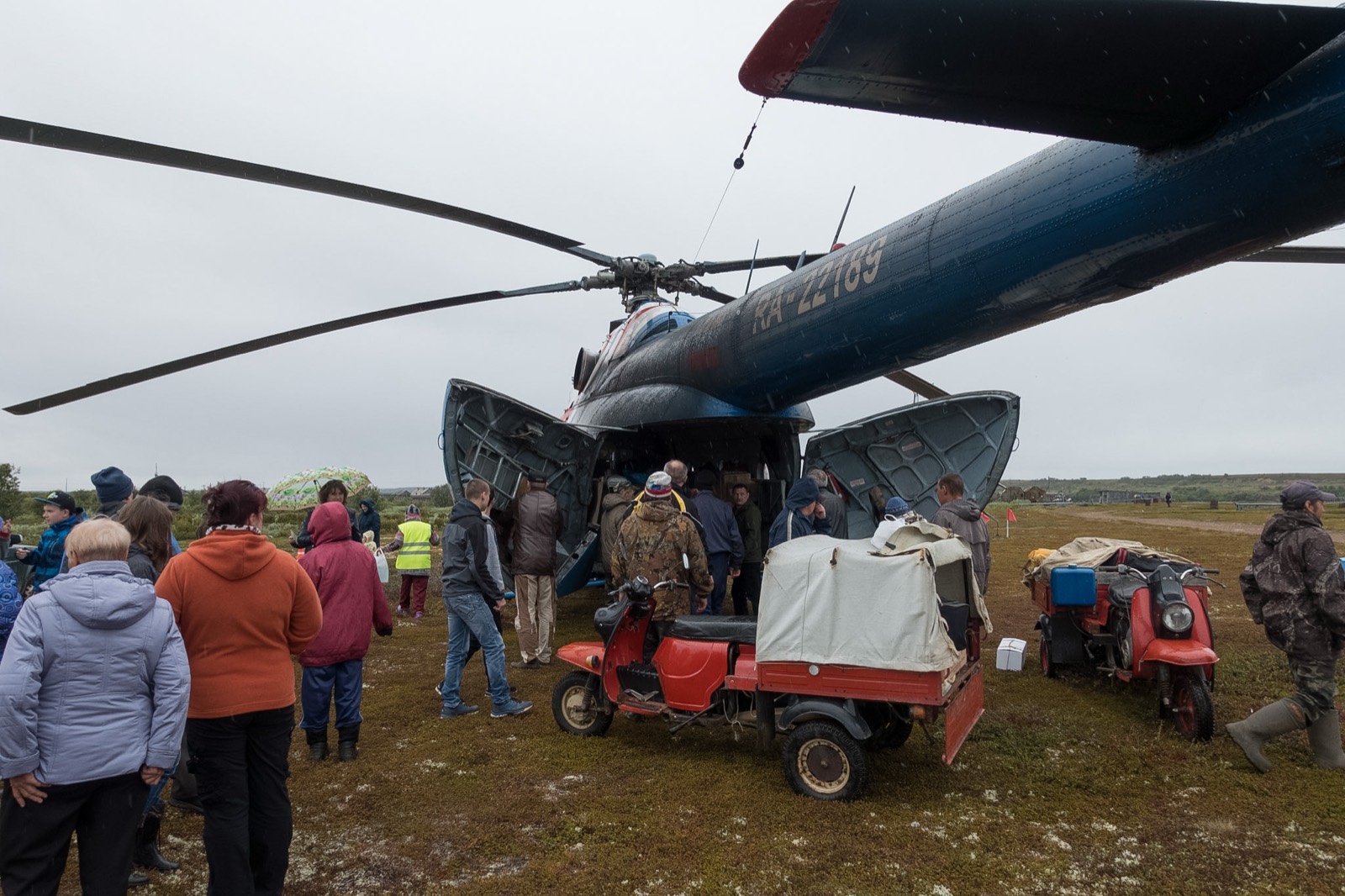
Just think, 3 days have already passed since we left Moscow, and we haven't even started paddling; never before has getting to the start of a route taken us so long.
We notice three modern wind turbines: one is standing but motionless and two are on the ground. It turns out they were installed recently, but someone apparently embezzled something somewhere and botched the maintenance, so instead of wind energy the whole village uses a diesel generator that's switched on for a few hours a day.
Under the rain that's started, we haul our things to the shore, pitch the tent, and cook lunch in our "hangar." Right off the bat the tent proves itself 100%. There's plenty of room in it, comfortable to sit, comfortable to cook in the rain.
The rain dies down, and we walk along the shore, swatting away clouds of mosquitoes, and begin assembling the kayak. A local elderly couple drives up in a blue "kopeyka" (Lada). They're off to check their net, complain about the fisheries inspectorate, and ask us to keep an eye on the horizon in case someone comes out from behind Sosnovets Island to catch them in turn.
While we assemble the kayak, a local babushka passes by and we strike up a long conversation about the sea, the local nature, the people, about what her children and grandchildren do for a living and how, who fishes where. We learn that cloudberries ripen here in three "waves" (we didn't memorize the exact term she used). The first — in the forest, the second — in the bogs, the third — by the sea, and judging by the color, there should be the most by the sea. But the sight of the bare bilberry bushes is not inspiring at all; in the coming week we definitely won't be eating the berries that so nicely brightened our days last year.
The low tide reveals a monstrous tidal flat that we'll have to trudge across tomorrow. Oystercatchers dart about everywhere — small black-and-white birds with bright red beaks — but it would be fine if they just darted, only they squeak shamelessly and incessantly. The motto of our trip is born: "Oystercatchers, f*** off."
Part 1Sosnovka → Chapoma
We get up at 4 a.m. to make the tide, which will begin at 6. We can't be late, nor start earlier: the tidal currents in the Gorlo are very strong, and only the flood tide will help us. Fighting the ebb is pointless, so we pack quickly, and just as quickly become convinced of the errors in our estimates — the tidal flat is significantly larger than we'd wanted, about 700 meters.
We drag the kayak with difficulty, park it at the edge of the ebb zone, and then I load onto myself, using a strap like a yoke, the IKEA bags loaded with stuff and the big duffel. Thanks to CrossFit, I can carry such a load, and even speed up a little to check whether I've tied the kayak well, since the tide has already started and is slowly lifting and carrying off our vessel. Everything is securely fastened; we load up already knee-deep in water and set out an hour and a half after the tide began. We've spent so much energy that we want to rest. But we can't.
The morning is cold, though sunny; the wind blows off the land and helps us nicely. The price for this help is that we're carried ever farther from shore. In this section the coast is so monotonous and devoid of any landmarks that it's hard to say how far out you are — a kilometer, two. We're carried out three, and at the end of the fourth hour, having done 25 kilometers, we decide to paddle toward shore, since we're not sure you can camp at Cape Pogorelsky, and we also fear the ebb might start and we won't reach it at all. We land by the Likhodeyevka cabin, and again the shore plays cruel tricks on us. From the water it's unclear what's where, and the shore itself lacks any pronounced inlets or capes, so we mistake a little shed for Likhodeyevka, but correct ourselves in time and finish our short day, falling just shy of 30 kilometers.
The ebb begins just as we finish lunch. Strangely, it comes about 40 minutes later than in Sosnovka, even though we've moved only 30 kilometers. Tomorrow we'll be testing this rule, and on the whole it will turn out to be more or less correct along the entire narrow part of the Gorlo. 30 kilometers along the coast shift the tide schedule by about 40-60 minutes.
We find reindeer antlers on the shore and pitch the tent on a knoll near the cabin. The cabin is pleasant, tidy, and convenient for hiding from the mosquitoes, which is what we do. Who do all these hordes of mosquitoes even bite when there are no tourists here?
We light a small fire, boil water from the stream, and go for a walk up to the survey marker. Yes, Cape Pogorelsky really isn't very convenient in terms of campsites. In fact, if you look at it from the sea, you might mistakenly decide you're facing the Crimean mountains rather than the Kola hills. In a little bog on the hill we find white-red unripe cloudberries, "rokhlets." It's completely unfit to eat, but the fact itself is sort of gladdening — the berry is ripening. The beauty of the tundra is intoxicating: flowers everywhere, varied moss, shrubs and bushes. So much life on such an inhospitable shore.
There's no road here, only the track marks of an all-terrain vehicle built on a BMP chassis, the one we saw in Sosnovka.
The ebb here isn't as terrible, and we won't have to drag the kayak more than 200 meters, so we go to sleep at ease.
In the morning we have breakfast in the cabin: there's no wind and mosquitoes crawl out from everywhere. We could, of course, eat in the tent, but why, when there's such a convenient option nearby. The morning is warm, 15 degrees, and we even take off our fleeces.
We set out right at the start of the flood tide, and immediately get the next lesson. The inertia of the water flows is such that, even though the tide is already coming in, the surface current remains ebb, and we can barely paddle. We have to put in behind Cape Pogorelsky and rest for 30 minutes. During this time we notice a white "Niva" stuck in a sand dune — two stories will yet be connected with it — and photograph, through binoculars, a bearded seal basking in the sun. It lets me get fairly close. A shame you can't take a quality photo through binoculars.
We set out and seem to be paddling our due 5 kilometers an hour, and we speed up a little. All day the sun shines mixed with clouds and a moderate headwind. We pass Pulonga and notice at least 4 yachts at the pier there. It would be interesting, of course, to chat with the yachtsmen, but we have to paddle. It started raining.
Paddling even against such a weak wind isn't very easy, and we decide to camp for the night by the Bolshaya Kumzhevaya cabin. It turns out to be occupied by a fisherman; he's sitting at a folding table on the shore cleaning fish. By all appearances he isn't local: a good motorboat, double-glazed windows installed in the cabin. He tells us about the nearest stream and gives us a huge pink salmon.
Having done 25 kilometers for the day, we camp beyond the stream on a knoll, again stretching our stiff legs with trips up and down. Ironically, as soon as we land, a powerful wind switches on that could have been a tailwind for us. Now it only hinders us from frying the pink-salmon steaks. They're simply magnificent and make up our entire dinner for today. It starts to rain, and the fisherman, having scouted that we've camped nearby, with some indignation invites us to stay with them — there are two more free bunks in the cabin.
At first we decline, but then we take halva and tasty tea and go over to hear stories from the life of a poacher from near Arkhangelsk. He told us a lot — about how Uncle Vova Kashura lives in Pulonga, a man known up and down the whole coast. In his cabin, by the way, there's a satellite dish, and we'd seen it; that in Pyalitsa there are already solar panels, and that the Niva beyond Pogorelsky was sunk by that same Uncle Vova, right after the fisherman, a car mechanic by trade, had fixed its clutch. Then they pulled it out with an all-terrain vehicle and just left it to rust by the sea.
The fisherman also tells us what to expect from the coast. The information proves useful, and in general, on this trip, talking with the locals gives more information than all the trip reports and maps.
We say goodbye and go to sleep. Yes, my theory about the 40-60-minute shift per 30 kilometers is confirmed, and we can afford to sleep in a little beyond the norm, since we no longer have to get up at 4 a.m. The difference from Sosnovka here is about 2:20.
The stream carves its way into the sea and greatly reduces the tidal flat. The idea of camping at river mouths pays off, and in the morning we load up very quickly. The weather, though, isn't much help. We paddle joylessly over smooth water. Occasionally a gust of wind sweeps in to cool us, but at an air temperature of +13, the sun bakes mercilessly — not for nothing did we slather on cream in the morning. All day we paddle toward the Nikodimsky lighthouse, and it has no desire to get any closer.
About 12 kilometers from the lighthouse, muffled rolls of thunder start reaching us from deep inland, and we move closer to shore. A bearded seal swims past, poking its head out of the water and puffing, studying us closely. The storm is somewhere far off, and we argue over whether a particularly spectacular anvil-shaped cloud will dump on us at two o'clock. By the way, it does dump, but just a little. On the approach to Cape Nikodimsky we finally decide it's time to stop being on the water, since off our right side is a storm front, a bit frightening in its power, and the headwind only strengthens.
Judging by the scattered, moss-grown logs, the "Nos" cabin has been gone for several decades, so any hopes of refuge in it are dashed. At the cost of considerable effort we haul the entire loaded kayak onto the shore, fearing a storm, and barely manage to pitch the tent before the downpour starts. A powerful headwind blows, while we calmly have lunch in the tent.
The storm front, as has happened before, shifts the wind to a tailwind, and now it's blowing up to 8 meters per second. We hurry, pack up, get on the water, raise the sail and immediately lower it, so hard are we pulled forward. Control is quickly lost in the gusts, and we decide to round Cape Nikodimsky on the paddles, especially since the wind drives us along at up to 7 kilometers an hour anyway.
Beyond the cape we raise the sail after all; we're carried along at 8-10 km/h, a strong wave washes over the kayak, sometimes lifting the stern out of the water. We have to steer with the paddle. Somewhere ahead Chapoma comes into view, and instead of the three houses we'd expected to see, no fewer than two dozen cabins and some structures appear. The imagination immediately paints a lively settlement, and we even discuss the possibility of camping farther from the village. A bit closer, it turns out there aren't that many houses after all, and inhabited ones, by the look of it, even fewer, and the structures are abandoned, so we confidently steer into the bay.
The 12 kilometers take about an hour and a half with stops; we kept having to adjust the piece of fabric under the sail.
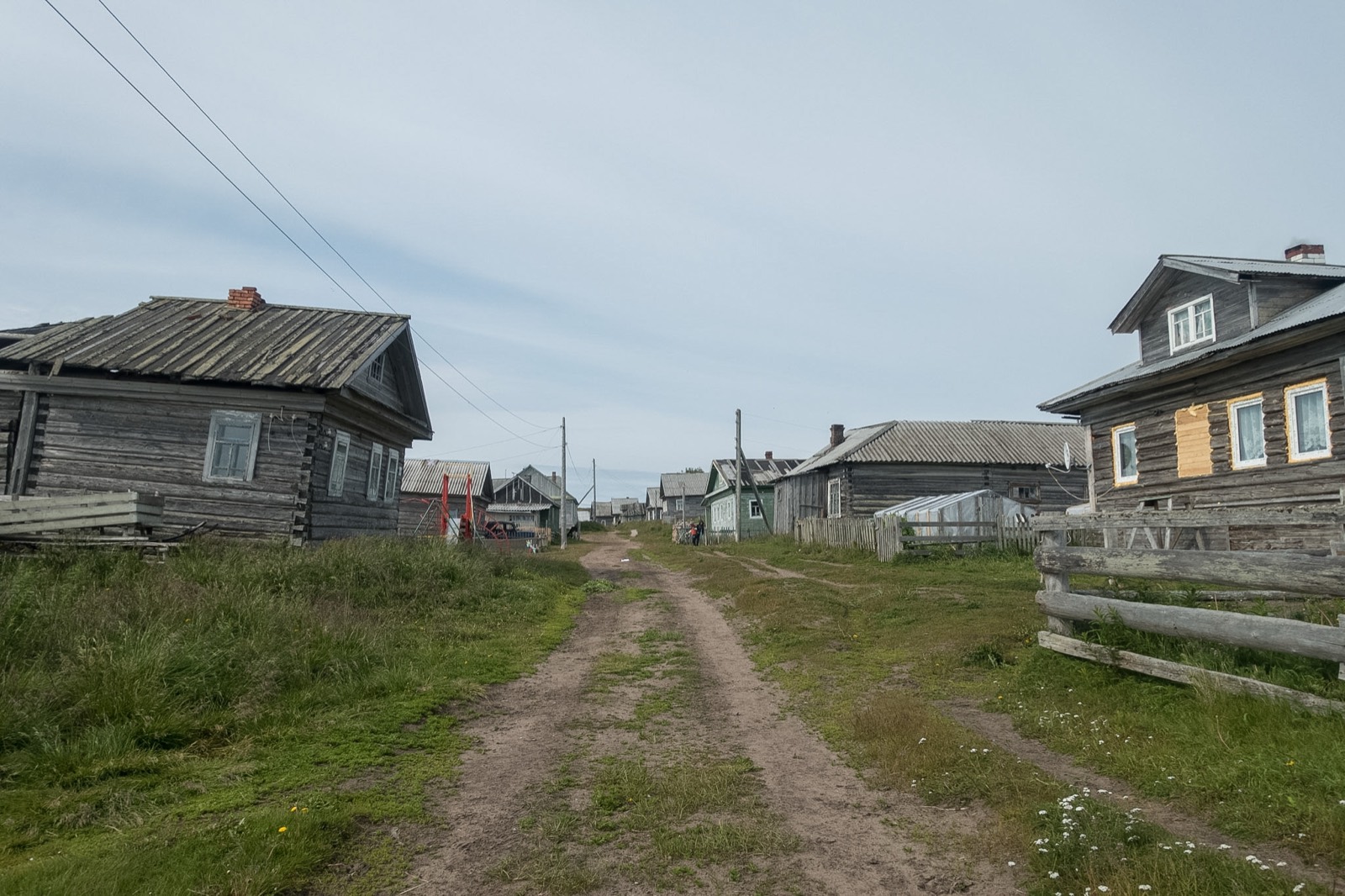
Chapoma, the main street
Chapoma has a good bay; we first camp on the cape, but an attack of terns forces us to move about 200 meters inland. There I ask the first person I meet for directions to Nadezhda's house. I'd found the "Faktoriya" lodge in Chapoma in advance and had meant to stay there. However, the lodge only operates during the salmon spawning season, which is about a month in May-June. The lodge's owner, Anatoly, said we could stay with Nadezhda, who works for them as a cook. Her house is quite close to the shore, and we're offered a warm room in which we hang up our things. We'll sleep in the tent in the backyard, though, since the house is, after all, too stuffy and the TV is on. We have no need for excess civilization.
As circumstances would have it, we arrive in Chapoma on Saturday, banya day. There's a little warm water left for us and a still fairly warm banya, and we wash ourselves and our clothes with pleasure.
They feed us dinner, and in the morning we go with Nadezhda and her friends to pick mushrooms at the old airfield. There aren't too many mushrooms, but enough for Dasha to make a fry-up with potatoes, mushrooms, and chicken. We chat with the locals, learn about life on the coast, and share information about the cloudberries we'd found.
For the locals, in principle, not many trades are left that can bring in money. Fish and berries, the same things that fed these people for centuries. Now tourism has been added to this, but it's more of a derivative of fishing and hunting. Of course, the thirst for profit leads to poaching, and more than once we hear indignant exclamations that some of the residents go way too far.
All day we eat, drink tea, and enjoy life. Toward evening we give the children rides in the kayak, and go to bed content.
We honestly didn't expect to meet so many lively, sincere, and genuine people here. Of course, the young people for the most part leave the villages, but on the Tersky Coast there's a visible trend in all the settlements of pensioners returning to it. They come, straighten up the cabins gone crooked with time, spruce them up and keep a household garden, go hunting, fish — in a word, live for their own pleasure. Grandchildren are immediately sent to them, and it seems there are more children here than adults.
A pleasant surprise is the dairy farm in Chapoma, which supplies the neighboring villages too. We get a kilogram of cottage cheese, some cream, and a liter of fresh-from-the-cow milk there. It's all very tasty, and we'll have this cottage cheese for breakfast for two more days.
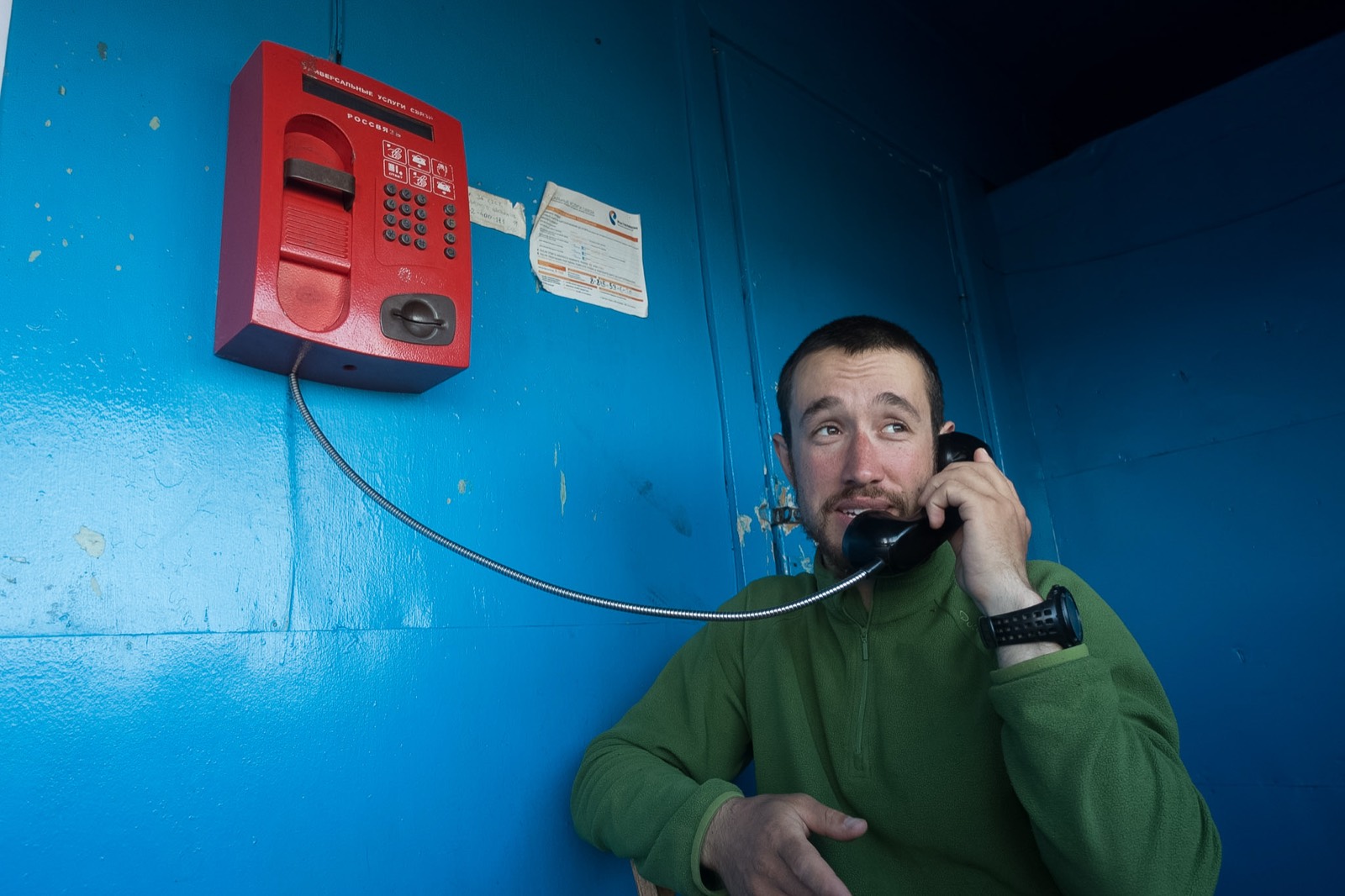
We call family and friends from the payphone; here it's the only means of communication, and its quirk is that phone cards for the payphone aren't sold and are only very rarely delivered to the shop. So the locals use the 3 free seconds that Rostelecom gives you to manage to say "call me back" to the person on the other end. Yes, you can call a payphone.
I chat with Oleg, a hunter; he tells me about the huge shoals near Kashkarantsy and about the bear bogs, which are best avoided. At the end of our long conversation Oleg treats me to three dried pink salmon, so now we have even more real food.
The pressure drops all day, and the locals say it bodes good weather. And just as steadily, all day a tailwind blows for us, the sun shines — everything you want on a travel day, you get on a rest day.
We rested very well, dried all our things, ate well, and had great conversations.
Part 2Chapoma → Kashkarantsy
But we're lucky, and in the morning the wind holds, though a light rain is falling. We pack quickly. Even too quickly — I leave the tent pegs behind. Seeing us off are the girl I gave a ride to yesterday, with her grandmother, and the little dog Zhulya. Zhulya clearly doesn't want us to leave; she barks at us.
We move out 200 meters, and I discover the GoPro is missing from the deck. I must have knocked it off with the paddle, since when we got in it was still in place. We have to stop and search the bottom, but it's all in vain — the camera is nowhere to be seen, and we can either wait for the ebb and search for it on the exposed bottom, with slim chances, or leave it here and go on. A shame, of course; I leave the woman our Moscow address and ask her to send the camera if it turns up.
Zhulya runs after the kayak, and when she realizes we've gone far, she stops and howls. How did this little dog manage to grow so attached to us?
The wind, of course, isn't as strong as on the day we approached Chapoma, but it's still enough for us to paddle minimally and race forward at full steam.
We reach Tetrino very quickly, try in vain to catch a signal there. We have lunch and leave on the beginning ebb. Fortunately, the wind and current are still on our side. The ambitious plan — to reach Chavanga — and we accomplish it, despite our general fatigue. Toward the end of the day the wind weakens, and we have to lean harder on the paddles and fight a weak current. On the approach to Chavanga the phone chirps happily, delivering a week's worth of texts, and at the next rest stop we call to say all is well with us and find out the forecast.
In total we cover 56.1 kilometers, an absolute record for us at this point.
We camp beyond the cape, so Chavanga stays behind the hill, with only the top of the cell tower visible — and that's enough to call everyone and update the forecast. It's not that we're tired of human company, but we do want to be alone with nature for a while. Since I successfully forgot the tent pegs in Chapoma, I have to improvise, and I make new ones from the bits of driftwood lying around everywhere. They turn out pretty well.
The wind suddenly dies down and we find ourselves besieged by an incredible amount of midges. We have to put on bug nets and light a fire. The water marked on the map isn't there, but I find some stream running down from the bogs. It's very beautiful here; we walk over the rocks.
During the night we wake up several times from the noise: the powerful wind, now shifted to the side, is hammering our flank — as it'll turn out later, one of the guylines has slipped off its peg, and now the tent's outer layer is furiously beating against the inner.
In the morning, of course, no midges at all — they've been blown far away and for a long time. We decide we can skip waiting for full ebb and set out on the still-receding water, so eager are we to use this wind. A quick pack-up, we're on the water, going 8-10 km/h, but not for long. As soon as we come out from behind the cape, the ebb current puts everything in its place.
The sail is fully inflated, the waves churn, but we're making 2-3 km/h even counting the help of the paddles. It's a failure, and we have to paddle toward shore, fighting the wind, to rest there a little and then throw ourselves into battle with renewed strength. We barely make it, spending a ton of energy.
The coast grows ever more overgrown with civilization. Besides ATVs, practically the only means of transport in Chapoma apart from GAZ trucks, we notice off-road vehicles and more and more brand-new houses. Yes, this trip is far more "civilized," though you couldn't tell that from the map.
After resting we paddle better now; the ebb current has weakened, as, however, has the wind. Our super-goal is to get past the mouth of the Varzuga; we fear there'll be nowhere to camp on the sands.
We stop for lunch 25 kilometers from the mouth. Our peaceful lunchtime routine is interrupted by a roar resembling a bear's. It's unsettling, even though it's clear it's not a beast roaring. We get up, turn around, and see that it's some guy. A good joke; we treat him to tea. Oleg is walking to Chavanga from Ustye, 45 kilometers on foot. We got to talking and it turned out he too had run the Murmansk Marathon. It's very unusual to discuss a marathon with a Pomor somewhere on the seashore. We give Oleg tea so he won't use up his own, and say goodbye to him. We'd come up to this shore while the water was still low, and even had to get out of the kayak to drag it about 200 meters, so we're in no hurry; we wait for higher water and head out to sea. The shoals really do grow noticeably, and I study the map closely for the minimal shoals. The wind, shifted to S-SE, picks us up and we race merrily forward. Toward evening we come up to the mouth of the Varzuga and decide the plan for today can be considered fulfilled — we cover 42 kilometers.
The shore is sandy; the powerful surf gives away shoals and banks. Terns nest on the shore, and a bit farther off, near a cabin, horses graze. Not the best set of neighbors, of course, but we don't want to go any farther at all. We were very tired yesterday, and today too we had to work, so for tomorrow we plan half a travel day.
While we pitch the tent, an old Niva with no plates drives up. In it are two guys, inviting us to the cabin to dine on ukha. We can't refuse something like that, but first we set up camp and eat our own food for dinner. The stallion and mare come up to the tent, study our dry bags closely, and go off to graze further.
The guys turn out to be good company, like everyone we met on the Tersky Coast. We listen to stories and learn that as a child one of them was sent to Uncle Vova Kashura in Pulonga for bad behavior, where he lived and worked. Many years later, he went to visit Uncle Vova in his Niva, "which had more vodka in it than gasoline," and left it there, flying off by helicopter. That's how we pieced together the story of the Niva beyond Cape Pogorelsky. The guys complain about the lack of work in Umba; they themselves occasionally fish here and earn extra money however they can.
We gorge ourselves on the most delicious yet simple ukha, warm up in the cabin, and go to bed content.
A large cabin for the fishing crew
We decide to make the next day a "half-day": we sleep our fill, have breakfast, stroll along the Varzuga, have lunch, and get on the water only by one in the afternoon. Our task is to reach Kashkarantsy, or thereabouts. The main task is to find a place to rest, so we don't get out of the kayak, and at one of the rest stops we finish off the cottage cheese with cream from Chapoma. Fatty food sustains your strength magnificently.
We pass Cape Korabl but don't dare stop to look for amethysts — rest is more important. We come up to the Umbsky Nevod cabins; they turn out to be in terrible condition, and we don't want to camp there. We go on, to the marked stream. From the water you can see its bed, which has cut through a rock outcrop, but no water is visible. We decide to camp a little past it, so that we can walk both to the river that's closer to Kashkarantsy and to the stream. On a rest day you need water.
We're pleased with the 33 kilometers covered and set up camp. My wooden pegs don't work as well anymore; I have to drive them into denser soil. Beyond the Varzuga the number of trees rises sharply, and now the forest is literally 100 meters from us. Ten meters away is a dirt road. It's full-on civilization here now. The main flow of cars goes farther, along the gravel track, so only the occasional off-road vehicle that knows about this turnoff along the shore will pass by us.
While we sort through our things, a cyclist rides past. We wave after him, and Dasha notes that he looks like Makar. He doesn't just look like him — it is Makar.
He'd located us by GPS tracker, come from Moscow to Kandalaksha with his road bike, and hammered out 220 kilometers in a day, so the next day is a rest day both for us and for him. In fact, even if we'd had a travel day planned, we'd still have stopped to rest on such an occasion. We've already covered 230 kilometers and are getting very close to the 2014 mark, even though only 7 days have passed.
Makar pitches his super ultralight bivy; we give him drink and food and share stories. Of course, Dasha and I had wanted to camp where there'd be no people, so we could enjoy each other's company, since over the past few days we'd met too many people, as it seems to us, but we're not in the least upset to see our good friend — quite the opposite, we're happy.
The first 450-gram gas canister runs out, so we're more than at ease about the rest of the journey (we have two more).
It pours rain all night, the wind only strengthens, and in the morning we find the sea in a terrible state. It's blowing up to 12 m/s and the whole horizon is covered with whitecaps. The shoals near shore rear up whole series of powerful chop. Paddling is out of the question and we wait out the storm. We sleep about 14 hours, then eat again, and eat, and eat. We see Makar off. A very hard moment — a lump even rose in my throat. Kostyan brought with him a little of that world we'd left behind, and now it's time for him to go home.
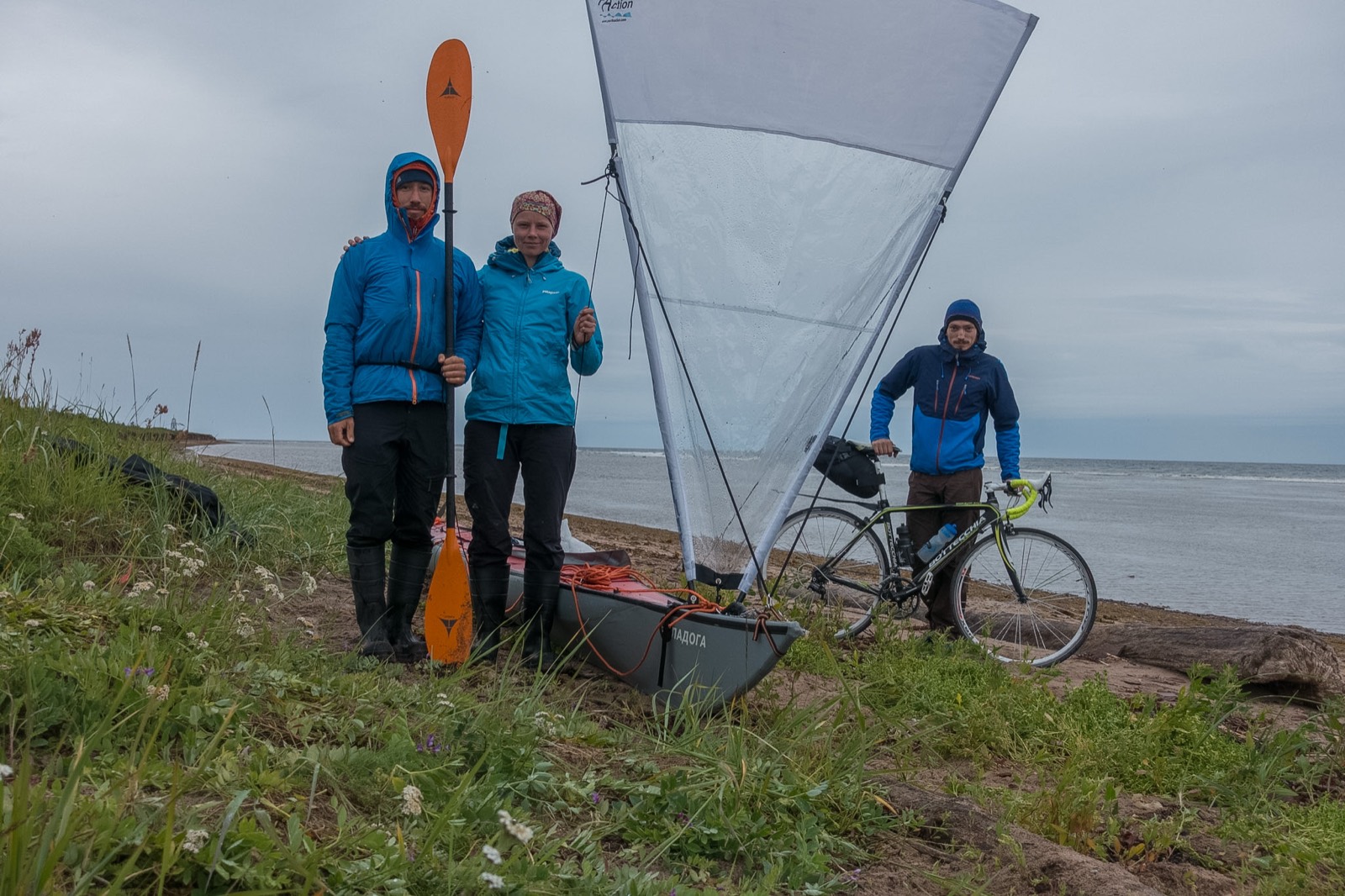
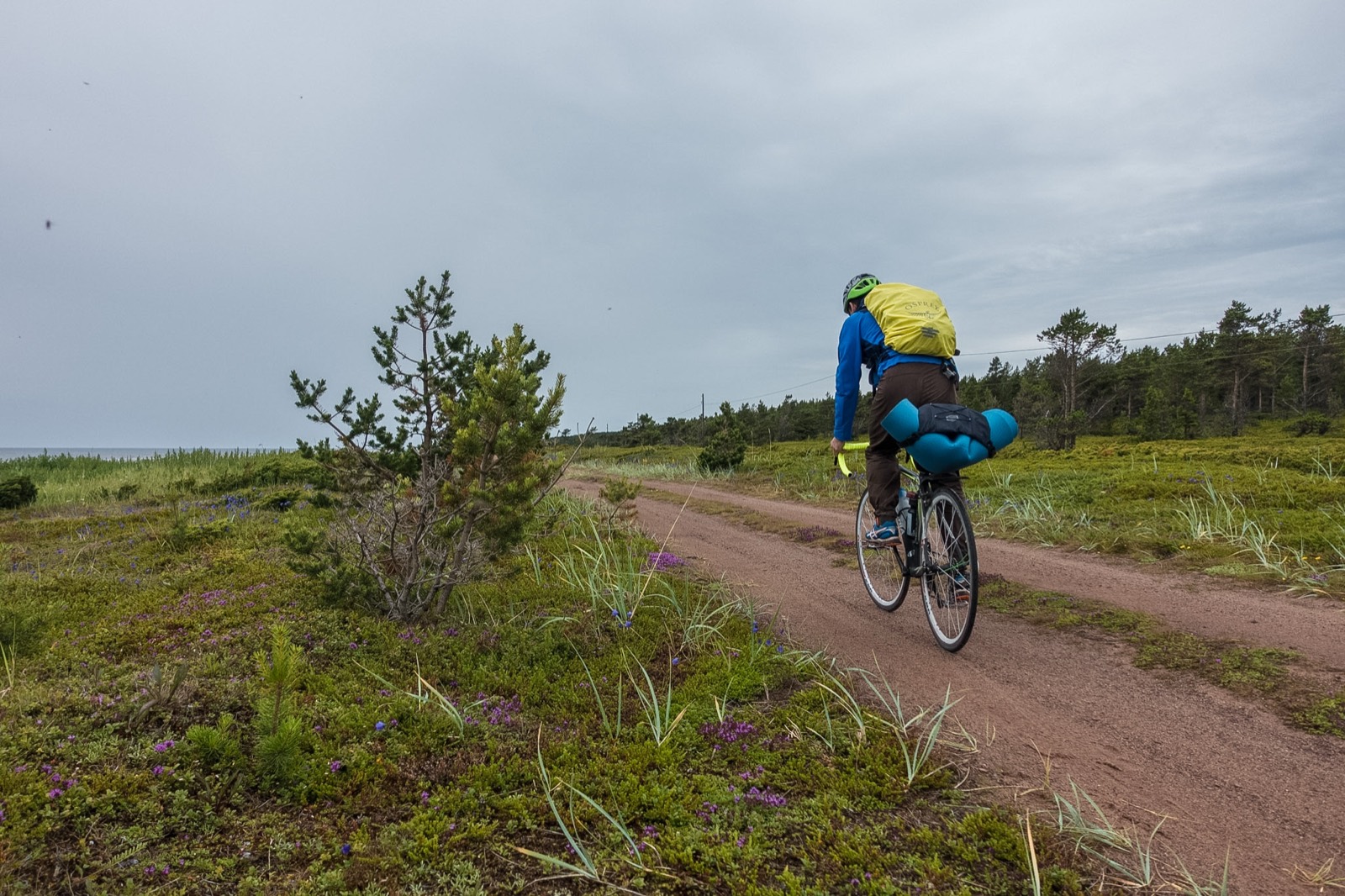
We stay, go for a walk along the shore. Everything is gray, ugly, and wet, so there's nothing to do outside, and we spend half the day in the tent. I'm not really any better; my nose runs all night. As luck would have it, at night I spill some of the remaining Tizin (nasal spray). I think it'll last to Umba, and there we can drop by a pharmacy.
Part 3Kashkarantsy → Umba
In the morning the wind dies down. We get up again at 4 a.m., except that now we miss the start of the tide in any case — it's right around 4-something. It's raining. At 6:10 we're on the water; we'd been packing up right by the sea, but much closer to shore. We get through the chop quite successfully; yesterday we spent all day watching the waves breaking on the shoal and found the spot where they're weakest. So all that's left is to wait for a set of big waves to pass and head out to sea on the small ones.
The wind keeps changing direction, but on the whole it helps, and we go 7-8 km/h.
The shoals here are utterly unimaginable, simply a nightmare — a kilometer to a kilometer and a half from shore you can still see the bottom. For three days the wind blew in one direction and drove up a high, long wave of about 1-1.5 meters, and now the N, NE wind raises only a slight ripple on the surface of these waves; they're fun to ride, but they also break with a roar on these shoals, and at one moment we even find ourselves in the lineup, and one chop even washes over us. We have to quickly bail farther out to sea. There's no doubt — we must get through the entire shoal zone, and it'll end past Olenitsa. The prospect of camping in Olenitsa and steaming in a banya (and today is Saturday) is, of course, appealing. Less appealing is the prospect of dragging the kayak a kilometer across the tidal flat, so we have to grit our teeth and paddle. We lunch on the water, finish off the cottage cheese with cream, eat all sorts of goodies and sandwiches. Already toward evening we round Cape Maly Oleniy and are glad our calculations proved correct. There are no more shoals here, just a small rocky bank. Beyond the cape is a fishing station, and the fishermen's big white dog immediately sets off to sniff out the unexpected guests.
I feel really unwell, and after pitching the tent I immediately crawl into the sleeping bag, leaving all the chores to Dasha. She stoically endures the attack of an endless number of midges, cooks lunch, after which I feel better. We stroll out to the cape and are glad we camped behind it rather than in front. After all, there's a kilometer-long tidal flat there.
We find mushrooms, fry them again. On the whole we devote the rest of the day to resting. The forecast is optimistic and our plan for tomorrow is a thirty-kilometer crossing to Cape Turiy. Right now we can see it on the horizon, looming menacingly out of the sea amid the clouds.
The next morning brings exactly that weak 2 m/s wind that was forecast, but it blows in our faces. Oh well, we're not proud. 5 km/h suits us, and we paddle at this pace for two hours, covering barely ten kilometers. At the next rest stop the wind changes direction and blows at our backs. And it does so somehow indecently strongly for two meters. The sail is already pulling us at 5-6 km/h, and thoughts begin to creep into my head that we're on open water, and if the wind tops 8 m/s, good waves will start — only it won't be so good for us. The forecast is partly borne out. It blows even harder, the whole sea looks as if stroked against the grain, waves hiss to the left and right, the stern rises over the waves now and then. We can't even rest properly; on the other hand, we're being carried along nicely. Halfway across the crossing, clouds hide the cape from view, and now before us is only a gray, featureless horizon. We navigate by GPS, but I try to follow the heading on the compass. An ordinary compass is, of course, terribly inconvenient; we'll have to buy a spherical kayak compass.
For three hours we exist in a strange state of simultaneous joy at the high speed the wind gives us and struggle with the waves caused by that very wind, and just on the approach to Turiy the wind switches off. Belugas surface first at a distance from the kayak, then very close, about twenty meters away. We admire the sheer cliffs of the cape and round it, by now thoroughly worn out.
Beyond the cape there are cabins, and we camp by them. Their inhabitants walk us to the nearest source of the purest water and give us two pink salmon. By the way, the cape has the cleanest water we saw anywhere on the White Sea. Apparently this is due to the pebbly bottom.
We go on past Khyamruchey and camp by yet another fishing station, near a stream. Here there's tall grass everywhere, everything is wet, and there's a fire pit in the forest. For about 40 minutes we search for a tent spot, and in the end we set up on the grass at a steep angle. I'm terribly hungry, but we decide to have ukha for lunch, so we still need to build a fire. I go to the men in the cabin and ask them for a bit of dry kindling to start it; they gladly share a couple of sticks, and within half an hour we're cooking ukha from fresh pink salmon.
Here there are birds everywhere with their already-grown chicks. An oystercatcher struts importantly across the tidal flat, and its chick follows, clumsily repeating every move. It's very interesting to watch such moments.
Right after lunch we start preparing for dinner; we need to make coals to bake the second pink salmon. Meanwhile the sky clears, and for the first time in several days we see the sun, and also the Karelsky Coast. That's it, we're very close to the goal now.
It seems to me we've never rested so well in such a short time. Apparently it does depend on diet, and two pink salmon are far better than freeze-dried meals and grains. We bask in the suddenly emerged sun, drying our sleeping bags and some things. Even though no water gets into the tent, the sleeping bags had still been gradually getting damp over the last 5 days, in conditions of constant humidity. It rained every day and we had to pitch the tent on wet ground.
The sun lifts our spirits and we go to bed full and content.
The morning brings mixed news. It seems the wind has died down, but that's an illusion. The high peninsula shelters us from the wind, which is raising powerful waves out at sea. About three kilometers from shore everything looks like a storm day. The water is calm only near shore, and we decide to go along the coast to Umba, and from there we'll decide as circumstances dictate.
Gusts of wind accelerate us to 12 km/h, and I keep trying to estimate how strong the wind is blowing on the other side of the cape. Before us is Volostrov, and the choice: to round it by sea and keep to the left, as planned, or to enter the safe strait and from there cautiously make our way to Umba. Our plan, actually, was first to reach the boundary of the Kandalaksha Nature Reserve, rest, and then set out on the crossing according to the weather, since you're not allowed in the reserve, not only on the islands but also at sea. So the crossing is only possible in good weather.
Having moved 2 kilometers from camp, we decide we can perfectly well round the island by sea, and head to the left. Our overconfidence, however, fairly quickly smacks us in the face with a slipper and shows that at sea there's no clear boundary between calm water and brutal stuff, and now two-meter waves are tossing us. Fortunately, the waves are long, but we still feel like we're on a roller coaster. There are still 3 kilometers to the island, and it's already clear the waves are only getting bigger, and you can see the powerful spray with which they break against the rocky shores. The waves begin to hiss, a bad sign, and we decide to drop the sail and turn 90 degrees to go sideways to the waves for a while. The side wind makes this less pleasant, but we're getting closer and closer to land, and the waves gradually diminish. In the strait the water is the calmest of all.
Generally it's hard to judge wave height in a kayak, and 30 cm will seem like a meter, but on this trip we clearly understood what a one-meter wave is. A one-meter wave reaches head level and hides basically everything on the horizon.
A two-meter wave reached the height of the sail and hid absolutely everything from view. I don't much want to find out what a three-meter wave is.
In the strait we take a short breather and set out toward the "health camp" near Umba, at least according to what the GGTs map said. For a while the paddling is quite comfortable; Volostrov shelters us from the wind, there's even a signal, and Makar immediately calls me to report that the previous day our Spot had stopped transmitting signals right during the crossing, which cost him a certain amount of nerves. I'm very glad that Kostyan took the business of tracking our progress so responsibly, and a little embarrassed that the Spot allows itself such screw-ups.
Meanwhile, the wind changes again and throws itself onto our right side. The shore isn't far, and the waves don't have time to build up much, but we have to brace almost to the limit. We decided to put up the sail to go faster, but these five kilometers drained all our strength. The wind kept strengthening, and every hundred meters came hard. We drew closer and closer; the cabins of the holiday base became distinguishable. As I'd expected, this place has long since ceased to be a health camp, and that's a good thing.
First thing, we find a guard who walks us to the common house. From the updated forecast it becomes clear that with a 15-meter wind we won't be going anywhere today, and besides it's high time for a rest day, so we gladly move into a free cabin.
Would you believe it, 9 a.m. and we've already finished paddling.
We haul out the kayak, order lunch and a banya, and enjoy the soft beds. Civilization bursts into our life instantly, except that the mobile internet here barely picks up anything. Nevertheless, we manage to refine the forecast, and it's not pleasing at all. Today there'll be a powerful wind all day, tomorrow more or less, the day after — a storm. After the storm the forecasts differed, but mostly, of course, they predicted rain and a change of wind.
We try not to think about it and get a good rest. We dry the kayak in the wind, eat, and spread all our things out in an even layer across the cabin. The Splav dry bags almost all leaked on this journey, so we had to take additional measures to insulate their contents. They're too thin, of course, and simply not designed for this kind of use. The cabin is dry, warm, and pleasant. How wonderful it is when you don't have to heat the space with the warmth of your own body!
After lunch we drive to Umba. Tatyana gives us a lift and takes us to the petroglyph museum, to old Umba, and tells us a lot of interesting things. Umba is a slightly depressing place. There used to be a timber mill here, and 12 thousand people lived in the settlement. But the mill closed; of the 12 thousand, 5 remained; people earn a living however they can, but mostly, of course, they just get by — some on fishing, some on tourism.
In the evening we go to the banya. At last, hot water and the chance to scrub a week's worth of grime off our bodies.
The evening's finale is a storm and pancakes with pine-cone jam. Elena, the cook and manager, after our daytime conversation about how hard it is to make and impossible to buy pine-cone jam, shared with us her own homemade delicacy. What could be better? A good forecast, of course, but it isn't improving.
The finale and a few conclusions
A powerful wind blows all night and calms only toward morning. A thick fog descends and visibility is limited to a couple hundred meters. The forecast isn't improving, and after long discussions we make the rather hard decision to end our trip here. We got far more from the sea than we could have imagined even in our boldest dreams.
We saw the beauty of the High Coast, the tundra stretching for tens of kilometers around without a single tree, saw the powerful tides of the Gorlo. We saw the living Tersky Coast, talked with very interesting, sincere, hospitable people. We heard a multitude of yarns, stories, and pieces of advice. These people are kind and open, but only to those who are open to them. Putting on airs gets you absolutely nowhere here and is more likely to close every door before you.
We got a couple of harsh lessons from the sea, learned to organize camp and daily trip life better in fairly uncomfortable conditions. All this time we had what we later called "a comfortable 12 degrees." The light base layers stayed in the dry bag the whole time; we always wore the warm ones.
Ahead lay the prospect of traveling in the rain, and still losing at least one day because of the approaching storm, and then getting soaked further, or leaving with what we'd already gotten. On the other hand, it's a very strange feeling — it all ended very unexpectedly. Over all this time we'd grown so accustomed to trip life that the looming prospect of returning to civilization seemed somehow completely incomprehensible.
We paid for one more day in the cabin and devoted it entirely to packing. We cleaned and dried the kayak so well that it probably hadn't been this clean in a long time. We dried absolutely everything, even washed most of our clothes.
We went to Umba and visited the museum of Pomor life, which had been closed yesterday. It's very interesting in itself, but on top of everything we had a great conversation with the museum's keeper, a Pomor woman from Chavanga. The conversation with her turned out to be almost more interesting than the museum itself; she told us a lot of fascinating things about the life of the Pomors, about the lives of her parents and ancestors.
The most interesting thing is that our impressions differ strikingly from everything we'd read, and later, analyzing our route, we came to the conclusion that the Tersky Coast can be traveled in a dozen different ways, and each time get from it exactly what you deserve. I was surprised by the number of interesting encounters and coincidences, and it was, perhaps, precisely they that elevated this outing-trip — so easy to make — to the level of a "journey."
What we agreed on is that the Tersky Coast is nothing at all like the Karelsky. It's "real," maritime. There's nowhere to hide from bad weather here, everything here is for real, and the sea here throws you genuinely grown-up challenges. You have to prepare for it seriously and responsibly, and a trip like this won't fly if you wing it.
I still can't believe all this happened to us, so complete was this journey.